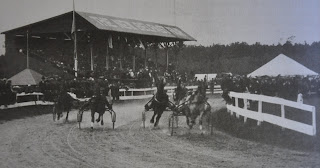
The Lost Trotting Parks Storyboard Archives

The Lost Trotting Parks Storyboard Archives

Saturday, August 29, 2009

1935 Map of Waterville -- Fire Protection


This map is the plan outlying districts show fire protection and pool locations in the city of Waterville -- Developed May 10, 1935. Follow the Oakland Road and note the location of the Penney Hill Farm. Hod Nelson purchased and sold property along the Oakland Road from 1882 through 1904. Financial issues arose after the death of Hod's trotting stallion, Nelson in 1909. Foreclosure started in 1910 and continued through the deaths of both Hod and Emma until 1916.

Thursday, August 27, 2009

Finding Sunnyside Farm (Waterville, Maine)


There is little photographic evidence of the location of Sunnyside Farm off the Oakland Road in Waterville, Maine. This illustration presents questions and information that we have found that will eventually lead us to Sunnyside Farm. A deed document describing the Inland Hospital property states that the property was the Baldic Farm and formerly Sunnyside. However, this location is more than 1.5 miles from the train station and only accounts for 22 acres. Join us as we pursue Sunnyside. Researchers working on this project include staff of the Redington Museum, Anne Palmer, Ann Beverage, Donna Trombley, Clark Thompson, and Stephen Thompson. Click the image in this post to see the illustration in full view. The comments associated with this post provide details of real estate transactions and foreclosures related to the Nelson properties.

Wednesday, August 19, 2009

The Trotting Park in Pittsfield Maine (located by today's airport)


Notes on Horse Racing in Pittsfield [from the book Pittsfield on the Sebasticook, which can be read on the Pittsfield Historical Society web site.


In June of this year (1893), Col. Morrill purchased the old Pittsfield Driving Park from J. E. Connor and Isaac Lancey. “The Colonel intends to make extensive repairs,” the announcement of the purchase stated, “building stalls, judges’ stand, seats for the spectators, improving the track, repairing the fences, and opening up a road from the park to Peltoma Avenue.”

The opening ceremonies were held in August and it was a great day for Col. Morrill, the new Union Park that had been practically idle for twenty years, and for the racing enthusiasts throughout the area. Special trains were run into Pittsfield, bringing one of the largest crowds ever seen at the Park.

The feature of the day was a ladies’ carriage race, the first in Maine. There was considerable doubt expressed when the event was first announced, but Morrill went through with it and it was a sensational success. He was later asked to put on a similar race at the other fairs in Maine and was invited to sponsor one in New Hampshire. It was the beginning of many “firsts” for Col. Morrill in his chosen field.

The careers of these two colorful personalities took divergent paths as the years rolled on. Dr. Drake, for personal reasons, probably financial, very shortly sold Early Bird to a Boston horse fancier, later sold his entire racing stock, and his beautiful estate, including his lovely home and his 450 acre farm.

The Hathorn Stable housing his thoroughbreds was afterward moved to the north side of the R. R. tracks where it housed the Eastern Maine Grain Co. for years and [later was] the home of the Wirthmore Feed Co. The inscription “Home of Early Bird” still shows through the paint on the west end of the building.

Pittsfield Advertiser, 1918 edition front page "Race Driven by Women," Col. Walter G. Morrill's Union Park race track.

He has owned some 50 race horses and he is today the oldest track devotee in the state. He was the first man to offer a purse of $1,000; first to stage a ladies’ race; and the first man to pay out a grand total of $100,000 in purses. He is the holder of the Congressional Medal of Honor for most distinguished gallantry in action, being the only man who left Maine as a private during the Civil War and came home in command of a regiment.

Col. Morrill was the first Maine man to put two horses into the 2.30 class, Surprise in 2.28 and Cammons[Connors?] in 2.25. The first race he staged was at Dexter on July 4, 1876. He then sponsored races in Bangor, Dover-Foxcroft, Skowhegan, Fairfield, Gardiner, Pittsfield and Waterville as well as at Lewiston, Topsham, Springvale, Rochester, N. H., and Brockton, Mass.

Guest of Honor
Pittsfield Advertiser, 1932

The Otis M. Vining Post feels that in dedicating September 2nd, the biggest day of Booster Week, to Colonel Walter G. Morrill, it is not only paying a tribute to Pittsfield’s oldest and most widely known Civil War veteran, but also is honoring a man that will go down in the horse racing history of the country as the premier horseman in America. Col. Morrill has paid out more money in purses to winning race drivers than any man in the country, and we as veterans challenge anyone to produce a man with his record, both in war and in sport.

Information provided by Tom Brown, Pittsfield Historical Society

Wednesday, June 24, 2009

Trotting at West Gardiner Lewiston Evening Journal 10/16/1889

Trotting at West Gardiner (Adapted)

The Kennebec Farmers and Stock Breeders' Association will have another day's trotting at Merrill's Driving Park, West Gardiner, on Thursday, october 17th. For the free for all class a purse of $100 will be given, and for the 2.50 class, $25.

Horses included Garfield, Almont Patchen, Hector, Gray Victor, Hulda, and Dr. Neal in the free for all class. In the 2.50 class, horses included Billy S., Draxy, Jocco, King Phillip, Watchmaker, Jr., John L., and Jack Witham.

NOTE: Following is a description of a road race. 
If you can help us retrace the route contact Stephen Thompson at lifework50@gmail.com. We plan to revisit and videotape the route.

At 10 o'clock a.m. first in order will be a scrub race open to all trotting and pacing horses, from the new Mills Bridge to Spear's Corner, round the square to Horse-shoe Pond Bridge, through Litchfield to Burnham Bridge and to Merrill's Corner. the celebrated horses Gen. McDuffy, John L. Sullivan, Harry Goodblood and Alcryon and many other good ones are entered.

The colt race will also be in the forenoon. The 50 class and free-for-all will be started at 1:30 p.m. The race will be mile heats with 5 to harness.

Lewiston Evening Journal Article courtesy of Clark P. Thompson. Posted and adapted by Stephen Thompson.

Old Orchard Beach Kite Track 1892-1907 --- 1936-1950


Millard F. Porter conceived the idea of building a mile racetrack in the marshland off Portland Avenue. He formed the Breeder Mile Track Association with other local hotel owners and businessmen, and a kite-shaped racetrack was constructed on hard clay. Horsemen competing here called it the fastest track in the world.

Lovers of light harness races came here for one the races from all over. A quasi-legal form of betting took place in hotes and at the track, but enthusiasm and attendance waned and at the kite track was idle by 1907.

In 1935-1936 a new group led by Fred Snow had the track resurfaced with hundreds of tons of clay and reopened pari-mutual wagering. Old Orchard Beach became a stop on the Grand Circuit featuring the fastest horses in the country. World records were set here.

In the first half of this century racing was as much a social event as a business. Horses arrived by train at the Old Orchard Beach freight station and were walked to the racing grounds. Flags flew, bands played, and it was an exciting time for everyone!

The final day of racing was July 3, 1950. The grandstand and othere buildings were soon razed and the famous track was recaptured by nature as marshland.

In 1975 the Wildlife Department bought a 600-acre tract including the racetrack with the intention of maintaining it as a wildlife management area.

Text courtesy of the Old Orchard Beach Historical Society

Kite Track (Breeders Mile Track) Old Orchard Beach

The Kite Track at Old Orchard Beach -- 1892 to 1950 Courtesy of OOB Historical Society

Saturday, June 13, 2009

The Trotting Tracks in Pinehurst, North Carolina

Greetings!

This year Libby and I ventured to North Carolina for school vacation. We visited our friends in Carey and together we travelled to the Outer Banks. At the same time, my cousin Clark and his wife Judy were visiting family. Clark had scheduled time in Pinehurst, NC to see friends who were training trotters at the Pinehurst trotting parks. My friend Phil and I drove the sixty-six miles to Pinehurst to see my cousin and the trotting tracks.

The first track is actually two tracks: a 1/2 mile and 5/8 mile. The second track is a full mile track. The tracks are owned the city of Pinenhurst and operated by the city's recreation department. If not owned by the city, these tracks would probably fall into the category of 'lost trotting parks.'

The tracks are used by horse men and their trotters until 1:00 pm. After 1:00 the community uses the tracks as walking parks.

Perhaps there is a lesson for us as we lose more open space to development. Trotting parks are typically prime real estate. Just maybe we need to look at preserving and celebrating our past, then to encourage real estate development that might possible occur elsewhere.

Stephen Thompson

Friday, May 29, 2009

The Bethel Agricultural Fair and Riverside Park


The Bethel Agricultural Fair and Riverside Park
by Yvonne B. Nowlin

While the next year's events were undoubtedly similar, even more attention seems to have been placed on horse trotting during the 1892 fair. Indeed, trotting events were to be held during the weeks before the actual opening of the fair in years to come. Announced as "a mark of great enterprise on the part of the managers of Riverside Park Association," trotting races took place on August 18th and 19th which included the famous trotter, "Nelson." Before the races took place "eminent horsemen" from Pennsylvania and New York inspected the track and pronounced it to be one of the best half-mile tracks in New England. Large crowds gathered to witness this sporting event of the season, before the actual fair took place. During the August trotting events, ladies of the Bethel Universalist Society furnished dinner at Riverside Park in their new "pavilion" erected on the grounds. Some forty feet long, and wide enough for two tables running throughout its length, the structure, in later years, housed the annual Universalist Sunday School picnic which was held during the first week of September.

The Bethel Agricultural Fair was held at Riverside Park Tuesday, Wednesday and Thursday, September 20-21-22,1892. Good purses were offered and the show of stock was large and of a high standard. Most important of many improvements since the previous year's fair was the construction of a large grandstand next to the trotting track. With its expanded facilities and interesting hall exhibits (held for the second time in the former Mayville Church), the 1892 fair passed as a very successful gathering for the promotion of local agriculture.


Riverside Park was located in the top left corner of this 1914 map of Bethel,
opposite Riverside Cemetery and just to the right of the numbers "657"
Map courtesy of Donald G. Bennett

Previous to the fair of 1893, the property on which Riverside Park was located was sold by Moses A. Mason to Charles Ryerson of Upton, Maine, for $10,000. The sale included the Mason homestead, its many out-buildings, and the nearby trotting track, as well as nearly 200 acres of timberland. A lumber operator and hotel owner, Ryerson had purchased the Lake House at Upton in 1875; he and his wife, Ellen, successfully managed this important hostelry for many years. Upon his arrival in Bethel in 1893, Ryerson began the reconstruction of the Mason homestead, which in its expanded form became known as the "Riverside House." Moses A Mason, the former owner, soon left Bethel on a trip that included the Chicago World's Fair and a short visit in Washington, D.C. (Apparently unsatisfied with other parts of the country, Mason soon returned to Bethel where he resumed residence and became a trustee of the Riverside Park Association.) The existing lease arrangement continued between Ryerson and the Riverside Park Association, for announcements of a trot and baseball tournament to be held August 22 and 23 soon appeared in local papers. For a special race held on August 23 between the horses "Griffin" and "Orvaissa" (the latter owned by G. W. Fernald of Bethel), reduced rates were offered to people taking the Grand Trunk to Bethel, and the Bethel Chair Factory shut down to allow workmen to take in the racing.


Riverside Park Opens August 8th 1891


Saturday, August 8th, 1891 -
The Grand Opening Trot of the Riverside Trotting Association opened at Riverside Park with a large crowd, much excitement, and plentiful self-promotion among the owner’s of trotters entered in the biggest Bethel event of the summer. Over $100 was taken at the gate. The Bethel Coronet Band provided fanfare, rhythms of enjoyable music and a lively atmosphere. Along with the trotting races, the Congregational ladies Fair at the Riverside Park were also very successful with over $100 being realized. Entries in the trotting program were as follows.

Green horses: $15.00 purse
General Gideon owned by Dr. Twaddle
John F. owned by Charles Farrington
Lady Chapman owned by Prof. Cjhapman
George K. owned by Geroge King
Sir Pryor owned by Smith Brothers
Butcher Boy owned by C.C. Bryant

2:55 Class Purse $25.00
Ehrlacher owned by L.A. Hall
Tom P. owned by Prof. W.R. Chapman
Redwood owned by H.L. Hastings
Mollie owned by Smith Brothers
Victor C. owned by E. Howe

Free for All. Purse $35.00
Owasso owned by G.P. Fernald
Fanny W. owned by Sheriff C.M. Wormell
Bell Boyd owned by H.L. Hasting
Wilder Patchen owned by Charles Farrington

Wednesday, May 27, 2009

Just One of Maine's Lost Trotting Parks


Can you identify the trotting park and its location from the outline of the park on this 1998 aerial photograph?

E-Mail Stephen Thompson at lifework50@gmail.com with the name and location of this trotting park!

Fairfield Trotting Park


Land for the Fairfield Trotting Park was purchased in 1874. A track was built and races were first held July 5, 1875. Currently, Anne Gunvaldsen, Vice President of the Fairfield Historic Society, is researching the history of the Fairfield Trotting Park, the trotters, and the people. The Fairfield Historic Society is open every Tuesday from 1 - 4 pm or by appointment. The History House is located at 42 High Street, Fairfield, Maine. The History House can be reach by calling 207-453-2998.

Fairfield Trotting Park Built 1874 - 1875

Thursday, May 14, 2009

Trotting in Belfast -- October 1864


Trotting at the Park

The Republican Journal October 7, 1864

The trials of speed at the trotting park in this city excited unusual interest this year, and drew a crowd of spectators. But for the unfortunate rain of Friday, which rendered any trial impossible, the fair would have been the completest, and most satisfactory in this respect ever held.

On Thursday afternoon, for the Society’s premium, offered for best trotting by horse four years old, Jenny Brooks, owned by Henry Edwards, of Brooks, took the premium in match against horse of M.W. Frost, Belfast. Time 3.10 and 3.11. In the afternoon, the premium for best trotter of five years old, was competed for by horses owned by Noah M. Gould and Alonzo Drake, both of Lincolnville. Won by Drake in 3.2, and 3 and 3. The Gould horse made the first heat in 2.58, but the driver lost the heat by violating the rules in endeavoring to take the pole from his opponent.
For the best trotting horse of five years old and upwards, animals owned by H. Hayford and Robert Patterson contested. Won by Hayford in three heats. Time 2.55, 2.57, and 2.58.
The heavy rain of Friday obliged a postponement for the Sweepstakes of $100 to Saturday afternoon. The crowd in attendance was the largest ever assembled in the park, and the excitement as the trot progressed was most intense.
The Sweepstakes was contested for by two Stallions names for Gen. McCellan, one owned by Horace McKenney, Esq., of Monroe and the other by George M. Robinson, Esq., of Augusta. Both horses were driven at the first heat by their owners. The trotting was to be decided by the best three in five heats. The Robinson horse is a dark by, of good trotting figure, with great reach of limb, and showing the marks of careful training. The Mckenney horse is a much handsomer and more symmetrical animal than his competitor, with compact muscle and lively nerve, but encumbered by fat and otherwise showing not a trotting conditions.
At the first heat, McKenney won the pole, and after several false starts the horses got off well together, and the heat was a steady struggle and tug of muscle throughout, amid the most intense excitement of the spectators. The Mckenney horse took the lead and maintained it throughout, despite the utmost exertions of his rival; both horses breaking for an instant during the heat, but soon settling back into a trot. Time 2.29 and 2.31. Mr. McKenney not being in condition to drive, from a recent sickness, Mr. Orrin Shaw, of Bangor, took his place for the remainder of the trot. McKenney’s horse was bleeding in one of his fore feet, from a cut, and was slightly lamed. At the second heat, Shaw had the pole at starting, but Robinson took it on the first quarter , the gigs coming in collision at the time. Robinson came in two lengths ahead. Time 2.31 and 2.32. The third heat was the least exciting of any. Robinson taking the lead, and maintaining it to the end. Time 2.28 and 2.29.

The fourth heat was a most exciting contest throughout, horses and drivers doiong their best, and the crowd of spectators strung up to the highest pitch of excitement. The struggle between the horses was a terrible contest of muscle. On the last half mile, the McKenney horse broke, and his competitor shot ahead, opening a gap of two rods. But he recovered handsomely, rapidly closed, and at the pole lapped his adversary half his length. It could only be said that Robinson won, with hardly an inch to spare. Time 2.26 and 2.27.
Mr. Robinson showed great skill in handling his horse, and the animal himself manifested intelligence and careful training. But the splendid figure and action of the McKenney horse enlisted the sympathies of the spectators from the first, and the belief was freely expressed that, in proper conditions and with fair training, he could repeat the trot and win. Several sporting men offered bets to that effect.

The trot was the best contested ever seen, and we doubt if a match ever again takes place here that will be attended with like interest.

Note: This article was provided through the research conducted by Clark P. Thompson of Bangor, Maine

Waldo Agricultural Society Reorganized July 3, 1847


The society was reorganized July 3, 1847; and a fair was held October 20, at Belmont Corner. Since then, the annual exhibitions have been held in Belfast, in the grove on Congress Street, in Bradbury's field, in the Smith field, on Wilson's Hill, and from 1860 in the grounds of the society. Rev. Nathan C. Fletcher delivered an address before the society in 1849, and Rev. William A. Drew, of Augusta, in 1850.
In 1860, a parcel of land on Belmont Avenue was purchased for holding the annual exhibitions, and afterwards surrounded by a fence. Within the enclosure is a trotting-park with a half-mile track. The first exhibition on these grounds was held Oct. 10-12, 1860, when the fees taken amounted to $595.
Excerpted from The History of the City of Belfast in the State of Maine by Joseph Williamson 1877

Wednesday, May 13, 2009

The Belfast Fairground and Trotting Park (September 1860)


Our thanks to Megan Pinette, President of the Belfast Historical Society, who met with us and shared with us photographs and other information regarding the Belfast Trotting Park. The Belfast Museum is located at 10 Market Street in Belfast, Maine. In the following slideshow, aerial photos of the track, photos of trotting at the track, and the map of Belfast depicting the trotting track were provided to us by the Belfast Museum. Current day photos were taken by Stephen D. Thompson.

Photo Essay of the Belfast Trotting Park

Friday, May 8, 2009

Help Us Identify Horses and People in Photographs Below!

The Penobscot Marine Museum located in Seasport Maine has kindly allowed us to use our blog to identify the people and horses in the photographs below. Kevin Johnston, who works for the museum, believes that these photographs may have been taken at the Belfast Trotting Park. Contact us at 207-242-7774 or e-mail lifework50@gmail.com if you have any information regarding these photos.

Your help is greatly appreciated.

Stephen D. Thompson

Click on the picture in the slideshow. Doing this will take you to Photobucket where you can carefully examine each picture.

Can you identify these photos

Thursday, May 7, 2009

Houlton Community Park


The History of Houlton by Cora Putnam describes three trotting parks that existed in Houlton, Maine. The 1872 Colby Atlases places a trotting park at the head of High Street. At the turn of the century a private track existed on the property of Lysander Putnam. This property was just off North Street where Maple and Bowdoin Street are located. In 1912, the Houlton Community Park was developed. The picture at right shows the Community Park in 1947. Today a track nolonger exists on the site. However, a fair is held each year in Houlton.

Monday, April 13, 2009

Rediscover Trotting Park History in Your Community


This post is your invitation to share your knowledge of a trotting park that may have existed or still exists in your community. Following are data points that would be of interest:
1. What year was the trotting park built? (Private or Public) (track size) (Name of Track)
2. Does the park still exist? Is it still operating?
3. Did any famous horses race at this park?
4. Were any trotting records set at this track?
5. What were the fastest times recorded at this track? (Name of horse)
6. If the trotting park no longer exists, when did it close?
7. What happened to the land? Was it redeveloped? For what purpose.
8. Does your local historical society have any photographs or text describing the history of the trotting park?

Maps from the 1800s with Trotting Parks